01
Contexts of intervention
Experience in clinical, community and operational settings, with work in psychological assessment and support.
Clinical Psychologist · Mentalization · Parenting

Welcome to a safe harbour to begin your journey of self-awareness, care and reflection.
About me
A synthesis of my path, interests and way of thinking about psychological intervention.
Sessions
Sessions in Portuguese and Spanish
Experience in clinical, community and operational settings, with work in psychological assessment and support.
Attention to occupational health, parental conflict, psychosocial vulnerability, anxiety, depression and personality functioning.
Practice informed by mentalization: understanding thoughts, emotions, intentions and relationships before reaching conclusions.
Portuguese action-research network in mentalization-based parenting interventions.
Top 5 in the Junior Professional Year Award — Ordem dos Psicólogos Portugueses, 2024.
Practice with regular group clinical supervision — part of a commitment to the quality and ethics of psychological support.
Before the first contact
Some practical guidance so the contact request is clear, reserved and appropriate to the clinical context.
The first session is dedicated to understanding the reason for contact, the current context, and what you expect from the process. It is also an opportunity to clarify any questions and assess whether this is the right fit.
Sessions are typically conducted online via video call, lasting approximately 50 minutes. Availability, frequency and practical arrangements are agreed individually.
Psychological support is guided by professional and ethical duties of confidentiality. Legal and ethical limits apply, for example when there is serious risk to the person or to others.
Current positions
Two active contexts of intervention — community and institutional — reflecting the central areas of clinical practice.
Associação Portuguesa de Terapia Familiar e Comunitária (APTeFC)
Facilitation of the Lighthouse Parenting Programme with former couples in the context of court proceedings related to parental responsibilities. The intervention takes place in two parallel groups, allowing work separately with each member of the former couple.
Centro de Medicina Naval (CMN) | Marinha Portuguesa
Work in naval military psychology, with intervention in institutional settings, occupational health, psychological support and coordination with multidisciplinary teams.
Internal dialogue
Duality is part of inner life.
Bringing what happens inside into the open helps recognise patterns and needs.
The aim is not to eliminate conflict, but to interpret and integrate it.

This way of thinking about behavior is at the core of the clinical approach.
Learn about mentalizationMentalization
A way of thinking about behaviour beyond the observable.
“Strive to ensure that the person sees themselves well represented in our minds”
The capacity to interpret behaviour.
To mentalize is to seek to interpret behaviour in the light of intentional mental states: thoughts, emotions, desires, fears, intentions, needs, fantasies, beliefs.
Emotional activation suspends reflection.
In states of intense emotional activation, the mind tends to lose this capacity: quick certainties, rigid readings and impulsive responses emerge.
Recovering curiosity as a therapeutic tool.
The work involves recovering curiosity, distinguishing facts from interpretations and building more useful hypotheses about oneself, the other and the relationship.
Lighthouse Parenting
The Lighthouse Parenting Programme is a mentalization-based intervention developed to support parenting in complex relational contexts.
The central aim is to help parents occupy a lighthouse position: a presence that illuminates, guides and offers a point of reference, even when the relationship goes through periods of greater tension or emotional storm.
The programme uses sea metaphors — such as the lighthouse beam, navigation, storm and safe harbour — to make reflection on needs, emotions, behaviour and relationship repair more accessible.
Current application with APTeFC
Within APTeFC, facilitation of the Lighthouse Parenting Programme is delivered with former couples involved in court proceedings related to parental responsibilities.
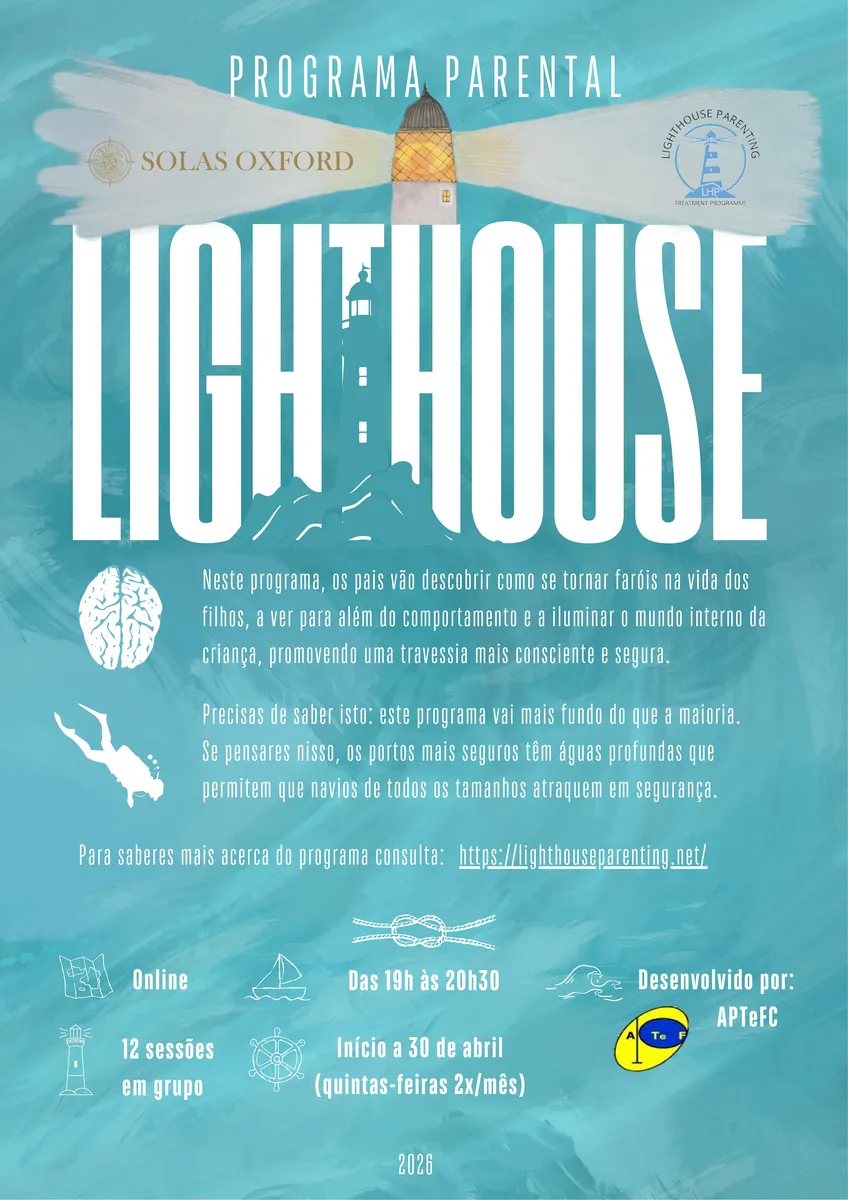
In situations of separation or divorce, conflict can become an intense source of suffering for parents, making communication and parental decision-making more difficult. When children and young people become involved in that conflict, the risk of emotional tension and responses centred on dispute increases, rather than on the relational and developmental needs of the children.
Psychological work seeks to foster reflection, differentiation between marital conflict and parenting, and safer forms of communication centred on the children.
Reference: Ordem dos Psicólogos Portugueses. (2025/2026). Intervenção Psicológica em Situações de Separação/Divórcio.
Organisational mentalizing
In high-demand workplace teams, the quality of work depends not only on technical skills, but also on the capacity to maintain curiosity, openness and flexibility towards the behaviour of others.
Mentalization for teams promotes the capacity to reflect on thoughts, emotions, intentions and needs — at individual, relational and organisational levels. This approach helps reduce rushed interpretations, improve communication, strengthen cohesion and recover the capacity to think in moments of stress.
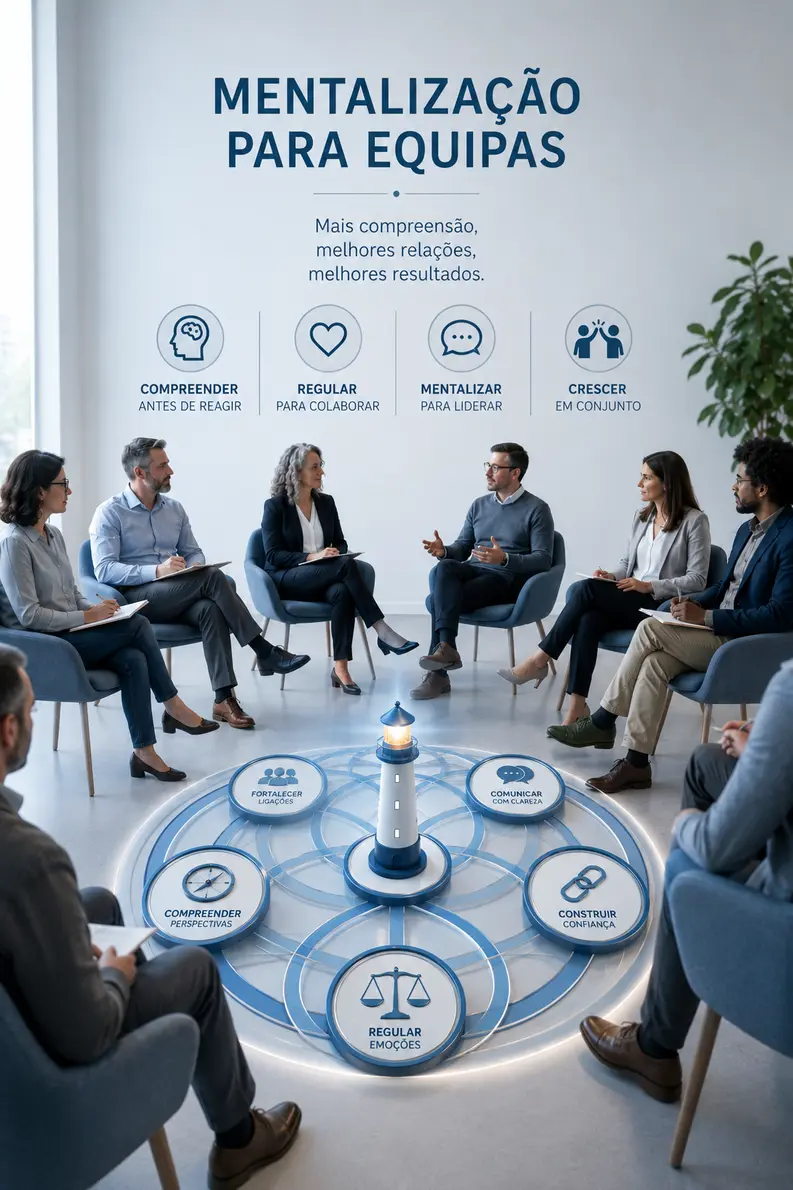
When a team faces a stressful situation, the natural tendency is to interpret the event more rigidly — centred on threat, error, blame or conflict. Mentalization introduces a reflective pause: it allows automatic interpretations to be questioned, other possibilities to be considered, and a more flexible reading of the situation to be recovered.
This capacity to return to mentalizing after a rupture — whether a conflict, an error, a difficult communication or an emotionally intense situation — is a central component of team resilience.
References
Operational context
In a military context, psychological readiness contributes to assessing and strengthening cognitive, emotional and behavioural resources in the face of operational demands, mission-related stress and the impact of family separation.
Intervention focuses on mental health literacy, early monitoring of operational stress, motivation, unit cohesion and psychological preparation for operational performance.

Morale is a central dimension of operational performance: it relates to motivation, sense of purpose, commitment to the organisation, esprit de corps, trust in the unit and vertical and horizontal cohesion.
In psychological readiness, morale should be understood systemically. It does not depend only on the service member or the unit: the family domain also matters. Family stability, communication, trust, preparation for separation and the perception of family support influence psychological availability for the mission.
When mission objectives are clear and meaningful, when there is trust in comrades and leadership and when family concerns are recognised and supported, the negative impact of operational stress on mental health and performance tends to decrease.
High morale contributes to greater occupational well-being, resilience in the face of risk factors and maintenance of operational capability.
Bibliographic references
Contemplative practice
The nervous system responds to stress with activation — acceleration, tension, looping thoughts. Mindfulness offers practical tools to interrupt that cycle: not by suppressing what happens, but by learning to observe it with greater distance and less reactivity.

When we perceive threat — real or imagined — the autonomic nervous system activates a fight, flight or freeze response. Mindfulness helps recognise these states and create conditions for the nervous system to return to balance.
It is not possible to control thoughts directly — but it is possible to change one's relationship with them, observing them as passing mental events.
With regular practice, it is possible to train attention to return to the present moment, recognise automatic thought patterns and create space between stimulus and response.
Choose an exercise and follow the suggested rhythm.
May support relaxation and help ease the transition to rest.
Cycle 1 of 4 · Inhale
Science
Academic and applied work in mentalization, parenting, teams and burnout prevention.
ResearchGate profileJournal of Infant, Child and Adolescent Psychotherapy, 23(4), 320–337
Article on the adaptation of the Lighthouse Parenting Programme to an online format and the changes perceived by participants in a mentalization-based parenting intervention.
Research in development
Project on mentalization with workplace teams in high-demand contexts and burnout prevention.
Project in development — no publication available.
Path
CRIAP
CRIAP
Escola de Fuzileiros | Marinha Portuguesa
Centro de Psicologia Aplicada do Exército (CPAE)
Santa Casa da Misericórdia de Lisboa — Unidade de Desenvolvimento e Intervenção de Proximidade (UDIP) Oriente
Solas Oxford CIC with Lifespan Psychology Centre
Gabinete de Serviço de Apoio Comunitário (GASAC) do Centro Juvenil de Campanhã
Faculdade de Psicologia e de Ciências da Educação da Universidade do Porto (FPCEUP)
Continuous learning
Complementary training accredited by the OPP, covering specialised intervention, ethics and transversal competencies.
Scientific communication
5 participations
Exploring the Impact of the Lighthouse MBT Program on Burnout and Resilience Among Social Care Workers
Navigating Together: Users' Voices in the Adaptation and Study of the Lighthouse Parenting Programme / Building a Safe Harbour: The Lighthouse Parenting Programme for Multi-Challenged Families
The Portuguese Online Lighthouse MBT-P: Feasibility and Caregivers' Perceived Processes of Change
The Portuguese Online Lighthouse MBT-P: Feasibility and Caregivers' Perceived Processes of Change
The Portuguese Online Lighthouse MBT-P: Feasibility and Caregivers' Perceived Processes of Change
Competencies
Areas that run through clinical practice, institutional work and applied research.
Institutional contexts
Family and parenting
Individual clinical work